> For the complete documentation index, see [llms.txt](https://community.commandersact.com/customer-success/llms.txt). Markdown versions of documentation pages are available by appending `.md` to page URLs; this page is available as [Markdown](https://community.commandersact.com/customer-success/expand-your-uses/server-side/leveraging-store-data-for-a-360-view-of-your-customers.md).
# Leveraging store data for a 360° view of your customers
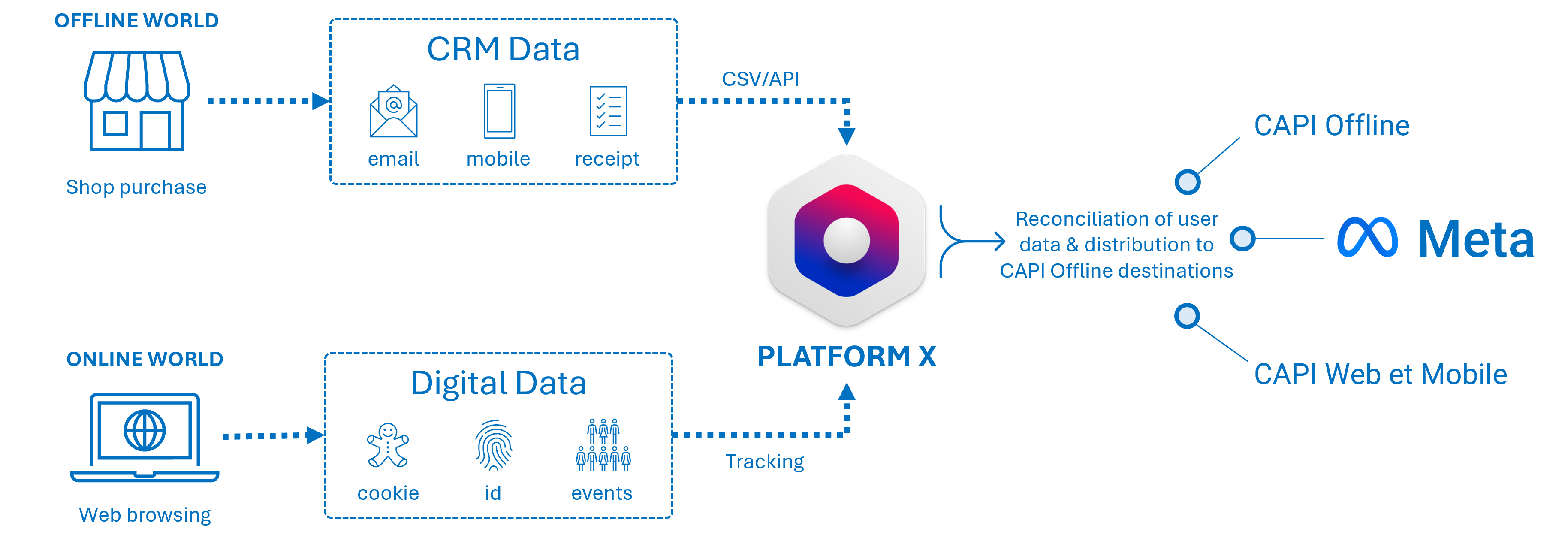
This guide explains how to reconcile your offline data flows (stores, call centres) with your digital ecosystem to obtain a comprehensive and actionable view of your customers.
### 1. Business value: Maximise performance through data hybridisation
Integrating offline data transforms your media strategy into an omnichannel growth engine by capturing value where it really lies.
* **Measured incrementality:** Attribute an average of 19% more purchase events to your campaigns (source: Meta), proving the real value of digital on physical sales.
* **Match Score Optimisation (EMQ):** By transmitting enriched reconciliation keys (email, telephone), you increase the ability of advertising agencies to recognise your customers and optimise delivery.
* **Augmented LTV Vision:** Identify your high-value customers who buy across all channels to personalise their experience and maximise retention.
### 2. Implementation Methodology (Action Plan)
To ensure accurate journey reconciliation, data ingestion and delivery are performed via a secure server-side infrastructure.
#### Step A: Preparation and Import of Offline Data Flow
Identify your in-store transactions and upload them to Platform X via the source catalogue (Conversion API, FTP or HTTP Tracking).
* **Documentation**: [Import your data via a Source](https://doc.commandersact.com/features/sources/sources-catalog/import-conversions)
#### **Step B: Normalisation and Event Inspector**
Use the control tools to verify in real time that the properties sent (Event Time, Action Source) comply with the standards of the advertising networks.
* **Action**: Validate the formatting via the Event Inspector before going into production.
* **Documentation**: [Event Inspector](https://doc.commandersact.com/features/sources/live-event-inspector)
#### **Step C: Destination Configuration (Offline CAPI)**
In your connector (e.g. Meta CAPI), map the imported events to the partner's offline conversion fields.
* **Documentation**: [Destination Catalogue](https://doc.commandersact.com/features/destinations).
#### **Step D: Monitoring via Event Delivery**
Verify that your offline conversions are being delivered and monitor the delivery ratio via the alerting system.
* **Documentation**: [Monitoring with Event Delivery](https://doc.commandersact.com/features/data-quality).
### 3. Typical use cases
1. **Offline-to-Online Tracking:** Attribute a sale made in-store on Saturday to an advertising campaign viewed on mobile the previous Friday to calculate your actual ROAS.
2. **Exclusion of Omnichannel Audiences**: Exclude customers who have already purchased the product in-store from your retargeting campaigns, thus avoiding unnecessary advertising pressure and optimising your budgets.
3. **Premium Lookalike Audiences**: Generate similar audiences on Meta or Google based specifically on your best physical buyers to recruit high-potential profiles.
### Need help unifying your store feeds?
Omnichannel is the foundation of a modern first-party strategy. Our experts will help you map your feeds to transform your offline data into a growth lever. **Contact our support team:**